

UX For Unknown Orbits
In 1977, NASA launched two Voyager spacecraft into the void of space, each carrying a golden, vinyl-like disc etched with the sounds, languages, and imagery of Earth. This “Golden Record” wasn’t a mixtape for Martians, exactly, it was a time capsule for any intelligent life that might someday find it. It included everything from greetings in 55 languages, to Chuck Berry’s Johnny B. Goode, to diagrams of human anatomy and solar system coordinates.
And while it was made for aliens, the Golden Record might just be the most ambitious user experience design project humanity has ever attempted.
Let’s break down what the Golden Record was, what it teaches us about UI/UX today, and dive into how its principles can influence modern web and app design.
The Golden Record
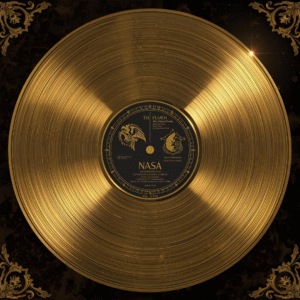
The Golden Record was a 12-inch gold-plated copper disc mounted on each Voyager probe. Designed under the guidance of astronomer Carl Sagan, it was intended to tell the story of Earth to any intelligent extraterrestrial life that might come across it, whether 10 years or 10,000 years from now.
It included:
-
115 images (encoded as analog signals)
-
Natural Earth sounds (wind, thunder, animal calls)
-
Musical selections from different cultures and eras
-
Spoken greetings in 55 human languages
-
Printed symbols and diagrams (including scientific and mathematical references)
In essence, it was a UI without screens, a physical, analog interface for beings who might not share our biology, cognition, or technology. And that’s where the genius lies.
We asked ourselves a simple but chaotic-genius question:
What would it look like if NASA had hired Scopun to design the Golden Record as a digital product?
That meant turning a philosophical artifact into a usable, scalable design system, a UI kit built to communicate across time, space, and species.
The Blueprint
-
Reimagine the Golden Record as an interactive, responsive design system
-
Showcase Scopun’s capabilities in design thinking, storytelling, and futuristic UX
-
Explore what it means to build for users without context.
Execution
Step 1: UX Strategy: Designing Without Assumptions
The first thing we need to do is to define user personas. Which is hard when your target users might have tentacles and no eyes.
We had to throw out all assumptions, no language, no color theory, no understanding of metaphors like “click” or “scroll.” This led us to design principles like:
-
Universality over familiarity
-
Sensory-first UX: visual, audio, haptic
-
Symbol-driven communication, inspired by hieroglyphs and math
TL;DR: Designing for aliens is like designing for toddlers, but in space.
Step 2: Visual System: The Golden Grid
We conceptualized deconstructing the original images and diagrams on the Golden Record and creating a modular grid system based on Fibonacci sequences and planetary geometry (yes, really).
The visual language included:
-
Circular UI patterns (like records, planets, atoms)
-
Contrast-heavy shapes for recognition
-
Zero reliance on typography, only symbols and glyphs
-
Color themes based on spectral light rather than RGB
Step 3: Audio-First Interactions
Inspired by the sounds embedded in the record, we hypothesized building a sound-based interaction system. Think of UI where:
-
Hover = tone shift
-
Click = musical chord
-
Navigation = melodic progression
Using real Earth sounds from the original Golden Record and mapping them to interactions, letting the interface “sing” its responses.
Prototype: The Golden UI
A fully functional prototype can be built in Figma (with Framer interactions) that simulates what an alien might “experience” if they opened the Golden Record today.
The prototype can include:
-
A visual homepage that cycles through Earth imagery in symbolic form
-
A soundboard that plays greetings and music based on waveform glyphs
-
A navigation system based on orbital mechanics (circular motion, infinite loops)
Plus a Figma plugin that translates user input into Golden Record-style glyphs.
Why This Matters (Even If You’re Not an Alien)
This was more than a fun experimental concept.
By curating a design for an unknowable user, we sharpened our approach to:
-
Accessibility: Can your design speak without words?
-
Information hierarchy: What matters when everything must be minimal?
-
Emotion through interaction: Can an interface feel like Earth?
And it reflects Scopun’s belief that design isn’t about screens, it’s about communication, empathy, and bold thinking.
How Scopun Applies This to Client Work
While we don’t expect to get a NASA contract (yet), this project shows how we approach all client challenges:
-
Complex use cases? We distill clarity from chaos.
-
Diverse audiences? We build for everyone, from first-timers to power users.
-
Big ideas? We make them tangible, testable, and beautiful.
Whether you’re launching an app for humans or building a dashboard that needs to speak across cultures, Scopun’s design-first, user-focused mindset delivers.
Let’s Build Something That Lasts
The Golden Record is still drifting through space, untouched, maybe unreadable, but undeniably beautiful.
If you’re looking to create something bold, timeless, and human, Scopun is ready.
Contact Scopun today.