
Looking for help with this? See our Magento development services.
Picking an eCommerce platform is a decision that feels small at the time and then quietly shapes everything for years afterwards. Shopify, WooCommerce and Magento dominate this conversation for good reason as each one is really solving a different problem rather than competing head to head. Magento itself now sits under Adobe with a free self managed edition called Magento Open Source and a paid enterprise edition called Adobe Commerce so you'll see both names used depending on which tier people mean. Get the choice wrong and you're looking at a painful rebuild within a year. Get it right and your store just keeps growing with you, without a platform switch getting in the way.
Online shopping isn’t showing any signs of slowing down. The UK Office for National Statistics said internet sales accounted for 28.3% of all retail spending in Great Britain in June 2026, the highest level since April 2021. That’s one reason this choice matters more than it once did. This guide breaks down each platform so you can make a more confident decision, whether you’re opening your first store or switching an existing one.
Quick Answer: Which Platform Should You Choose?
Want something fast, hosted and easy to maintain? Shopify is usually the better fit. Already running WordPress and want full content and design control without giving up flexibility? WooCommerce makes sense. Running a large, complex catalogue with custom workflows and you've got the budget and technical team to back it up? Magento, through Adobe Commerce, is built for that kind of scale.
There isn't really a single winner. It comes down to your budget, your technical resources, how big your catalogue is and where you want this business to be in a few years.
Shopify: Best for Speed and Simplicity
Shopify is a fully hosted, software as a service platform. You're not managing servers, patching security holes or losing sleep over hosting uptime, because Shopify handles all of that quietly in the background.
Strengths
Quick to launch, often within a few weeks for a standard store
Built in hosting, SSL and PCI compliant checkout
A large app marketplace covering shipping, marketing, loyalty and accounting
Solid uptime and reliable performance during big traffic spikes and sales events
Shopify Plus available for high volume merchants who need enterprise features
Trade offs
Monthly subscription plus transaction fees on some payment gateways
Less flexibility for highly custom functionality compared to open source platforms
Ongoing app costs can quietly add up as your store grows
For product first brands and merchants, Shopify is ideal because it saves them the hassle of managing infrastructure allowing them to focus their efforts on marketing. Our team can develop and tailor a Shopify store for brands looking to get their product to market in minimum time without sacrificing on design or performance.
WooCommerce: Best for Content Driven and WordPress Based Businesses
WooCommerce is a free open source plugin that turns a WordPress website into a fully working online store. It's currently the most widely used eCommerce plugin for WordPress, largely because it hands store owners full ownership of their code, content and hosting environment, nothing is locked away behind someone else's platform.
Strengths
Free core plugin so you're only paying for hosting, theme and extensions
Deep integration with WordPress content tools, ideal for blog led or SEO focused stores
Thousands of plugins covering payments, shipping, subscriptions and marketing
Full control over source code and data, since you own the hosting
Trade offs
You're responsible for hosting, security updates and backups or you need a development partner who is
Performance depends heavily on hosting quality and plugin choices
Can get harder to manage as plugin count and catalogue size grow
WooCommerce works well for businesses that already publish content regularly, run a WordPress site or care a lot about SEO control without giving up store functionality. We build and support WordPress and WooCommerce stores, covering setup, plugin configuration and performance tuning.
Magento (Adobe Commerce): Best for Large, Complex Catalogues
Magento started out as an open source platform and today lives under Adobe, offered as both a free open source edition and a paid enterprise edition called Adobe Commerce. It's built for merchants who need deep customisation, multi store management or B2B functionality that smaller platforms just can't stretch to cover.
Strengths
Highly customisable architecture, suited to complex product catalogues and workflows
Strong support for multiple stores, currencies and languages right out of the box
Handles large product volumes and high transaction loads well once properly optimised
Extensive B2B features in the Adobe Commerce edition
Trade offs
Requires skilled developers for setup, customisation and ongoing maintenance
Hosting and development costs run noticeably higher than Shopify or WooCommerce
Longer build timelines, often several months for a full implementation
Magento suits established retailers, wholesalers and B2B sellers with catalogues running into thousands of SKUs, multiple regions or complex pricing rules. It's rarely the right place to start for a new or small store since the development overhead outweighs the benefit until you actually reach that kind of scale.
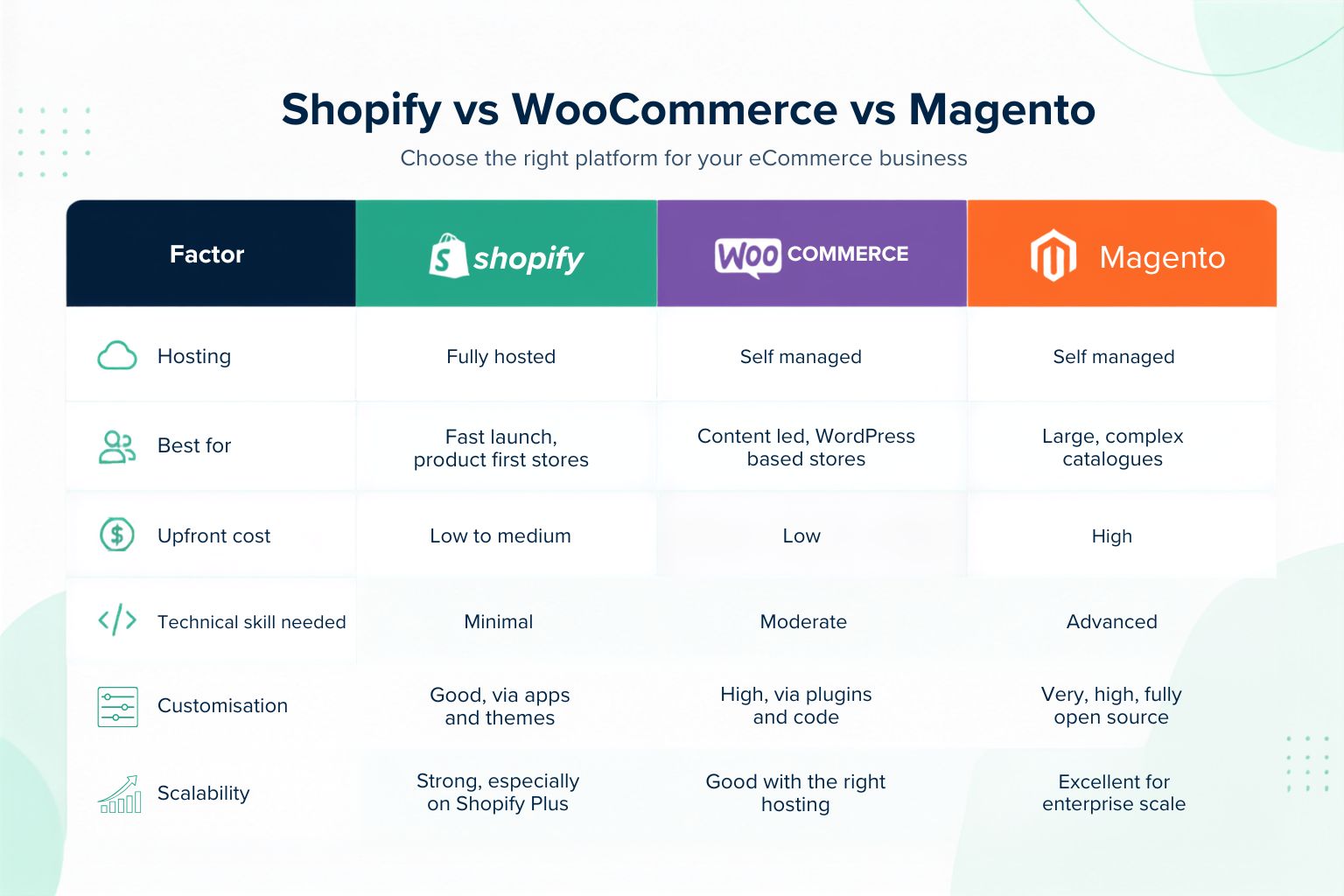
Shopify vs WooCommerce vs Magento: Side by Side Comparison
Key Factors to Weigh Before You Decide
1. Budget, Both Now and Later
Shopify gives you a predictable monthly cost. WooCommerce can be cheaper to start but adds up through hosting, premium plugins and developer time, it's easy to underestimate. Magento typically demands the biggest upfront and ongoing investment of the three. Look past the launch cost too and think about maintenance, updates and support over the next two or three years, not just the first six months.
2. Catalogue Size and Complexity
A store with fifty products behaves nothing like one with fifteen thousand SKUs spread across multiple regions. Shopify and WooCommerce comfortably handle small to mid sized catalogues, while Magento is built for large, multi warehouse or B2B operations.
3. Technical Resources
No in house developer? Shopify cuts the maintenance burden the most. WooCommerce needs a partner who understands WordPress, hosting and plugin management. Magento almost always requires a dedicated development team or agency behind it, there's no real way around that.
4. SEO and Content Strategy
WooCommerce, being built on WordPress, gives the most native flexibility for blog content, landing pages and technical SEO. Shopify has closed much of that gap over the years but still has a few structural limits around URL handling. Magento supports strong SEO too but it needs proper configuration to actually deliver on that.
5. Growth Plans
Think about where your business will be in three years not just where you're launching from today. A brand planning to scale internationally with complex pricing might outgrow Shopify or WooCommerce sooner than expected, while a small store doesn't need Magento level infrastructure from day one, that's overkill more often than not.
If you're not sure where your business sits on this scale our website audit checklist is a useful starting point for assessing your current setup before committing to a platform migration.
Common Mistakes Businesses Make When Choosing a Platform
Choosing Magento for a small catalogue because it sounds enterprise grade, then paying for infrastructure they don't actually need
Choosing WooCommerce without budgeting for proper hosting which leads to slow load times and lost conversions
Choosing Shopify and expecting unlimited custom functionality without factoring in app costs
Migrating platforms without planning SEO redirects which causes a drop in organic traffic
Underestimating how much time product data migration takes on large catalogues
How Scopun Helps You Choose and Build the Right Store
At Scopun, we work across Shopify, WooCommerce and Magento so our recommendation is based on what actually fits your business, not on whichever platform we happen to be limited to building. Our team handles everything from platform selection and store architecture through to custom development, migration, payment gateway integration and post launch support.
We start by understanding your catalogue size, budget, team capacity and growth targets, the same factors covered in this guide, before we recommend anything. From there we design and build a store that's fast, secure and structured for search visibility from day one and we stick around for maintenance and optimisation once you're live.
If you're still weighing up Shopify against WooCommerce or Magento, talk to our team for a clear, honest recommendation. Contact Scopun today to start planning your eCommerce build.
Frequently Asked Questions
Is Shopify better than WooCommerce for a small business?
It depends on what matters most to you. Shopify is generally faster to launch and easier to maintain since hosting is included which suits small businesses that would rather avoid technical upkeep altogether. WooCommerce can work out more cost effective over time and gives you more control if you already use WordPress for content and blogging.
Can I switch from WooCommerce to Shopify later or the other way round?
Yes, platform changes happen all the time. They are possible but they need careful planning for product data, customer details, order history and SEO redirects. If the move is handled badly, your search rankings can drop for a while so it helps to work with a team that has done this before.
Is Magento too expensive for a small online store?
For most small stores, yes, honestly. Magento's real strength only shows up with large catalogues, multiple storefronts or complex B2B pricing. The development and hosting costs usually aren't justified until a business genuinely reaches that scale.
Which platform is best for SEO?
WooCommerce, through WordPress, generally offers the most native SEO flexibility for content and blogging. Shopify has closed much of that gap with better native SEO tools of its own these days. Magento supports advanced SEO too but it needs proper technical setup to actually perform well.
Do I need a developer for WooCommerce?
Not always, for a very basic store. But most businesses genuinely benefit from a developer or agency handling hosting setup, plugin configuration, performance tuning and security. This matters more and more as your product catalogue and traffic grow.
Our service
Magento development services
Magento 2 and Adobe Commerce builds, upgrades and support from a UK team.
Got a project this article applies to?
Tell us what you need — free consultation, we reply within one business day.