

Looking for help with this? See our SEO services.
The top SEO mistakes UK businesses should avoid in 2026 include ignoring search intent and keyword research, weak technical SEO and Core Web Vitals, thin content that fails Google's E-E-A-T standard, poor internal linking and skipping optimisation for AI Overviews and answer engines. Fix these together rather than one at a time and you'll move a UK website from invisible to genuinely competitive in search results.
Search behaviour in the UK has changed faster than most businesses have kept up with. Ofcom's Adults' Media Use and Attitudes 2026 report found that more than half of UK adults, 54%, now use AI tools such as ChatGPT, Copilot or Gemini with uptake reaching 79% among 16 to 24 year olds. Meanwhile, online spending keeps climbing with internet sales making up close to 28.8% of all UK retail sales, according to the House of Commons Library's analysis of ONS retail data. Put those two things together and it's clear why a website still running on old SEO habits is quietly losing customers to competitors who've kept pace.
We put this list together from the patterns we see again and again when auditing UK websites, big and small. Some are years old and still surprisingly common, others are new and driven by how fast AI search has moved. Google's own guidance on generative AI in Search is worth keeping in mind throughout. Its AI features draw on the same foundational SEO practices as classic search including helpful, reliable, people first content. The basics still matter. They just leave far less room for error than they used to.
Where UK Brands Are Getting SEO Wrong in 2026
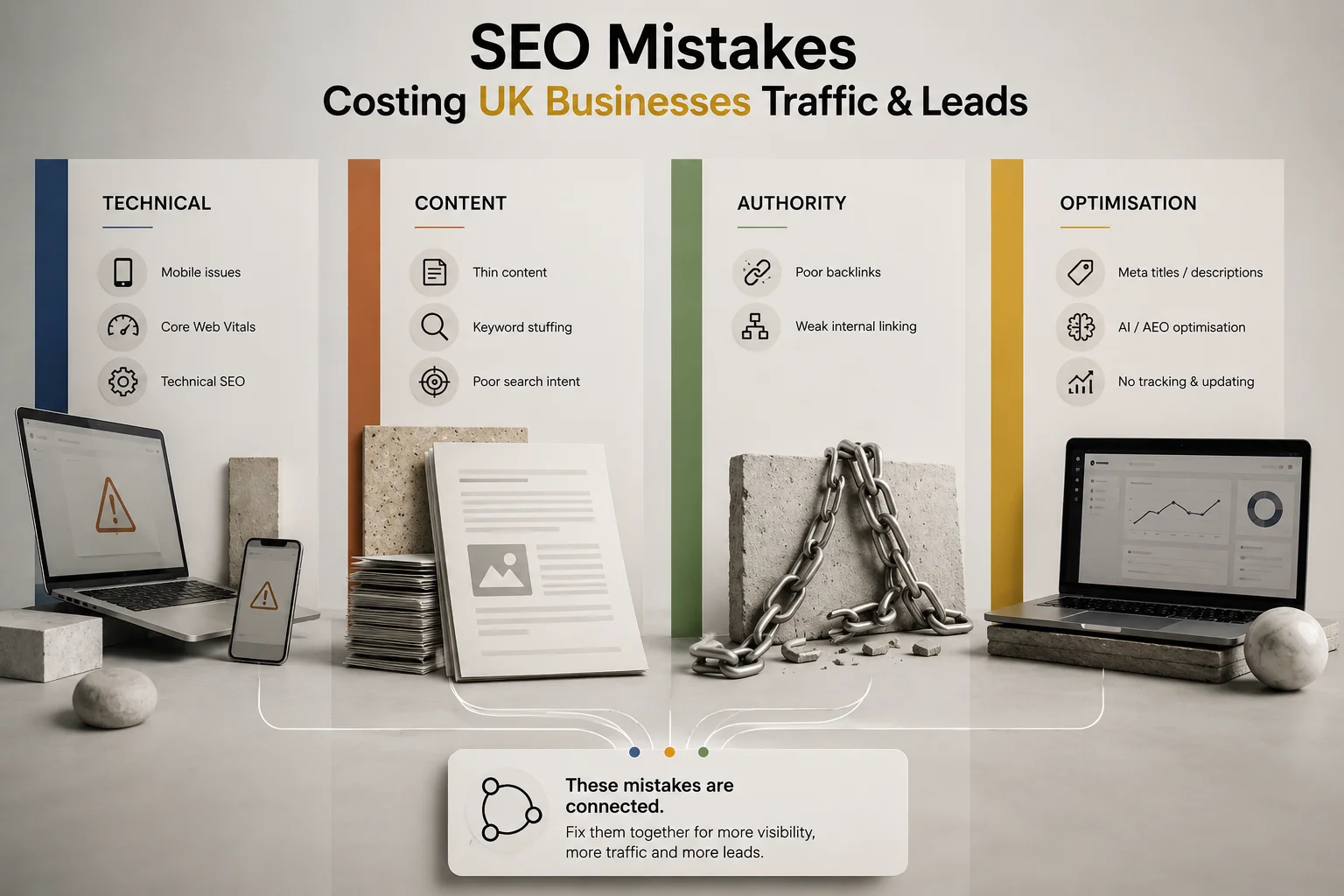
Here is a closer look at the ten biggest mistakes holding UK websites back today, along with what you should be doing instead.
1. Skipping Proper Keyword Research and Search Intent
A lot of UK businesses choose keywords based on a hunch rather than any real data which leads to content that targets the wrong phrases and misjudges what someone actually wants when they type a query into Google.
Worth doing instead:
Use Google Search Console or Google Keyword Planner to see real search volume and variations people actually use
Group keywords by intent (informational, commercial, transactional) so you're not mixing a blog reader with a ready to buy customer
Give each page one primary keyword plus a handful of related terms, rather than repeating the same phrase over and over
This is something we build into the planning stage of every web development project at Scopun so a site is set up to rank before it even launches, not patched afterwards.
2. Ignoring Mobile First Indexing
Google indexes and ranks your mobile site first, not your desktop one. Most UK adults now go online on smartphones so a slow or broken mobile site works against how people actually browse.
The usual culprits:
Text that's too small to read without zooming in
Buttons and menus that are fiddly to tap accurately
Pop ups that swallow the whole screen the moment someone lands on the page
Images and scripts that haven't been compressed, dragging out load times
3. Keyword Stuffing Instead of Natural Language
Cramming a phrase into every sentence used to work. It doesn't anymore. Modern natural language processing reads for meaning and relevance, not word count. Overstuffed copy reads awkwardly to a real visitor too which hurts conversions as much as rankings.
A better approach is to use your primary keyword once or twice in the places that matter. The title, the opening paragraph, a subheading. Let synonyms, related terms and ordinary conversational phrasing carry the rest of the page.
4. Weak Technical SEO and Core Web Vitals
Technical problems quietly cap how well a site can rank, no matter how good the writing is. Broken links, missing alt text, duplicate title tags and poor Core Web Vitals scores all chip away at performance in the background.
A basic audit should cover:
Page speed and Core Web Vitals: loading, interactivity and visual stability
Crawlability, through your robots.txt file and XML sitemap
Structured data (schema markup) for products, reviews and FAQs
HTTPS security and the mobile usability reports inside Google Search Console
It's a big part of why we treat SEO as a foundation rather than an afterthought whenever we design an ecommerce website since a fast, technically sound store tends to convert as well as rank better.
5. Thin Content That Fails E-E-A-T
Google has been pretty direct about this: content should be made primarily to help people, not to game rankings. Its Search Central guidance on people first content puts it plainly: content that's created primarily for people, rather than to manipulate rankings, is the thinking behind E-E-A-T: Experience, Expertise, Authoritativeness and Trustworthiness.
Too many UK sites still publish short, generic pages that don't say much. To fix that:
Add genuine expertise, such as case studies, original data, author bios and real credentials
Answer the whole question a visitor came with, not just the easy half of it
Keep pages updated as prices, facts or regulations change
Show clear business information and reviews so people (and Google) have reason to trust you
6. Duplicate or Missing Meta Titles and Descriptions
Your meta title and description are the first to impress a searcher even before they click. Leave them blank, duplicate them across pages or stuff them with keywords and it drags down click through rates and rankings alike. Every page deserves a unique title under roughly 60 characters. Also a description that honestly sums up the page while still giving someone a reason to click.
7. Ignoring AEO, GEO and AI Overview Optimisation
Answer Engine Optimisation (AEO) and Generative Engine Optimisation (GEO) aren't niche add ons anymore, they're part of a complete SEO strategy. With over half of UK adults already using AI assistants regularly, content that's structured to be easily quoted or pulled into an answer has a genuine edge.
A few practical things to try:
Answer common questions directly and concisely near the top of the page, rather than burying the answer three paragraphs in
Use subheadings that match how people actually phrase their questions
Add FAQ schema so answers are easier for search engines and AI systems to lift out cleanly
Prioritise original, well sourced information over generic summaries, since Google's own advice favours genuinely helpful content over shortcut tactics aimed purely at AI visibility
8. Poor or Non Existent Internal Linking
Internal links do double duty. They help visitors find their way around and they help search engines work out which pages on your site matter most. A surprising number of UK business sites have no internal linking strategy at all or link randomly with no real logic to it. A stronger approach ties related service pages, blog posts and support pages together naturally within the writing, the way this guide links through to Scopun pages like Shopify development or the FAQs whenever it's genuinely relevant.
9. Low Quality Backlinks or No Link Building at All
Buying a batch of cheap irrelevant backlinks can do more harm than good and even trigger a penalty while ignoring link building altogether leaves a site with little authority to draw on. The middle ground works best: a smaller number of genuinely relevant, high authority links does more than hundreds of low quality ones. Digital PR and original research tend to earn these naturally, without the risk.
10. Not Tracking, Measuring or Updating SEO Performance
SEO is ongoing work. Businesses that publish content and never check it again miss the chance to improve pages that are nearly ranking well or fix pages that are losing traffic. Check Search Console regularly and update pages that are not performing well. This works much better than publishing content and forgetting about it.
Building an SEO Strategy That Avoids These Mistakes
The benefits of fixing these ten mistakes one by one are significant but the true benefits of performing SEO will come from understanding it as a single unified system rather than a checklist: technical foundations, content quality, on page optimisation, internal linking and continuous measurement. That's the way that we work with web development and ecommerce website design at Scopun. We build the SEO in from the beginning, not append it on afterwards. Our full offerings list is available on the services page and other guides such as this are available on our blog.
Ready to Fix Your SEO in 2026?
If any of these sound familiar, they're probably costing you visibility, leads and revenue every month they go unaddressed. Scopun works with UK startups, SMEs and growing brands to audit, rebuild and optimise websites so they hold their own in traditional search and the newer wave of AI powered search alike. Get in touch with Scopun today for a free consultation and find out exactly where your SEO stands.
FAQs
How long does SEO take to show results for a UK business?
Most UK businesses start to see meaningful movement in rankings and traffic within three to six months with stronger results building over six to twelve. Competitive industries and newer websites usually take a bit longer to get there.
Do backlinks still matter for SEO in 2026?
Yes, they're still one of the strongest trust signals a site can have but quality matters far more than quantity now. A handful of relevant, high authority links beats hundreds of low quality ones which can even work against you.
Is keyword stuffing still a problem in modern SEO?
It is, even though most people know they shouldn't do it. Search engines and AI systems have got much better at spotting unnatural repetition and it reads badly to real visitors too which hurts conversions as much as rankings.
How much does SEO cost for a small business in the UK?
It really depends on the scope of the work and whether it's bundled into a wider web project. Packages typically range from a few hundred pounds a month for local businesses up to several thousand for more competitive, national campaigns. Scopun's pricing page breaks down flexible options based on business size and goals.
Does AI search like ChatGPT or Google AI Overviews affect traditional SEO?
It does but it builds on the same foundations rather than replacing them outright. Google has confirmed that its AI features on Search rely on the same core SEO practices so a business that's already doing the fundamentals well is generally in good shape to show up in AI generated answers too.
Our service
SEO services
Technical SEO, content and local SEO for UK businesses.
Got a project this article applies to?
Tell us what you need — free consultation, we reply within one business day.